
AI and Robotics Drive Productivity Gains as Daedong and Rural Development Administration Demonstrate Smart Agriculture Results on the Ground
-. Daedong and RDA share data and technologies while advancing joint pilots to accelerate AI-driven agriculture in Korea
-. RDA AI disaster alerts and farming data integrated into the Daedong Connect app, earning positive feedback from farmers
-. Field trials of precision agriculture and transport robots demonstrate effectiveness and reduced working time
Daedong (Co-CEOs Kim Jun-sik and Won Yu-hyun), a leader in future agriculture, announced on January 23 that its smart agriculture partnership with the Rural Development Administration (Administrator Lee Seungdon, hereinafter RDA) is delivering tangible results in real farming environments. The collaboration is strengthening AI-based farming support and advancing precision agriculture technologies, while expanding a practical public–private cooperation model across agricultural fields.
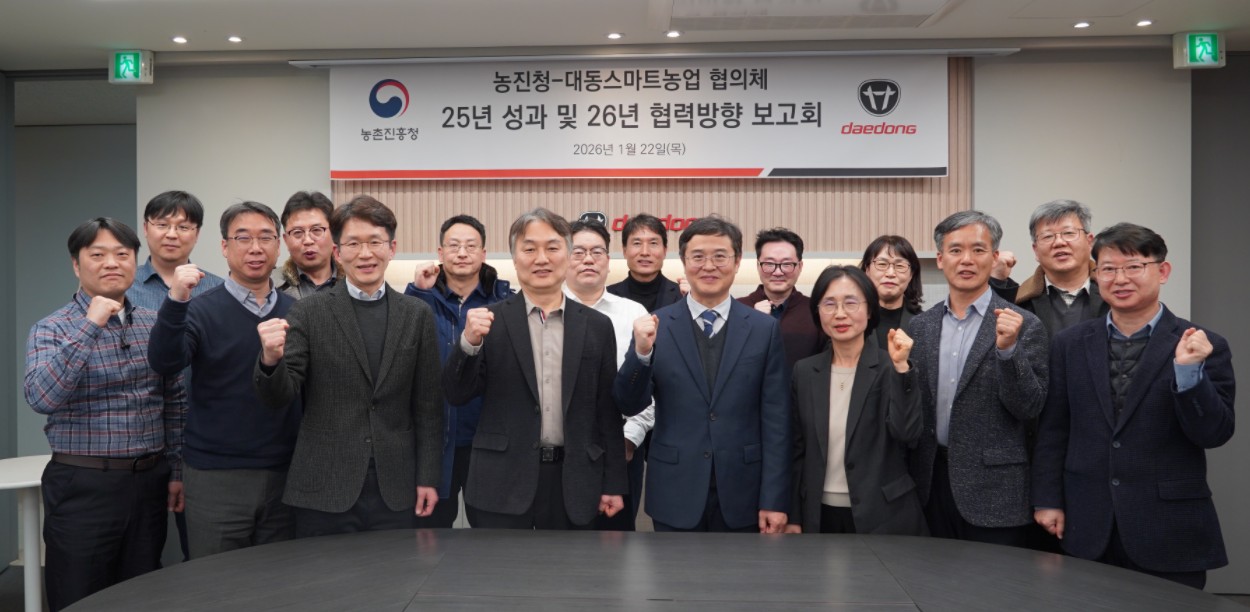
Daedong and the RDA launched the Smart Agriculture Cooperation Council in May 2024 and have since pursued 18 joint initiatives across four key areas to support the large-scale transition to AI-driven agriculture in Korea. The initiatives focus on data, precision agriculture, green bio and smart farming, and on-site deployment. In 2026, the two organizations shared major outcomes at a performance review meeting and discussed priority collaboration measures aimed at further advancing AI agricultural technologies and speeding up their application in real farming environments.
Within the data-focused working group, Daedong developed an “AI disaster alert service” using the Rural Development Administration’s Agricultural Weather Disaster Early Warning Service API and introduced it to the Daedong Connect app in August last year. The service is the first AI-based agricultural disaster prediction solution in the private sector to be commercialized in Korea. Based on individual field and crop data, it alerts farmers to potential disaster risks up to 10 days in advance and provides stage-specific response guidelines for cultivation. The service applies ultra-precise weather disaster forecasting at a 30-meter resolution, a significant improvement over conventional five-kilometer grid forecasts, and has been positively evaluated for enhancing farmers’ ability to prepare and respond in advance.
Daedong has also upgraded the agriculture-specific consultation capabilities of “AI Daedongi,” which has been trained on RDA farming data. The enhancement focuses on improving consultation accuracy through comprehensive learning across pest and disease management, cultivation techniques, and reference materials for 12 major crops. As a result, cumulative user inquiries surpassed 100,000 by 2025, with more than 8,000 consultations conducted on average each month, reflecting rapidly growing demand for digital, AI-based farming support, according to the company. Daedong plans to further expand the Daedong Connect app, which surpassed 40,000 registered users last year, by adding an AI call-based farming log service in the second quarter of this year.
In precision agriculture, Daedong conducted field demonstrations across 231 plots nationwide, reducing fertilizer prescription error rates to 4.29 percent. Following variable-rate fertilization, nitrogen uniformity improved by 73 percent compared to conventional methods. The correlation of topdressing maps generated using satellite and drone data reached 0.97, confirming that satellite data alone can deliver crop growth maps with a level of precision comparable to drone-based analysis. Following these outcomes, Daedong plans to further expand the on-site deployment of satellite- and drone-based fertilization technologies.
On this foundation, the company aims to establish a “full-cycle, data-driven precision agriculture system” by 2026. Key initiatives include refining practical technologies such as optimal fertilizer rate calculation, reduction of environmental load, development of rice protein estimation models, and lodging area detection. Daedong is also developing a precision agriculture platform that allows farmers to easily access the information they need via both web and mobile applications. Looking ahead, the company plans to expand the platform’s capabilities to include automated topdressing prescriptions, free satellite-based crop growth monitoring, and agricultural task outsourcing functions, broadening the service to support farms, local governments, and corporate users alike.
As Daedong continues to deliver concrete results in the data and precision agriculture segments, the RDA has expanded the scope of collaboration by leading technology validation and industrialization efforts through its green bio and smart agriculture field deployment working groups.
In green bio initiatives, the RDA identified Orange stonecrop, a functional plant known to improve sleep quality, as a strategic crop and conducted cultivation trials. Daedong, in turn, verified the potential for productivity gains compared to open-field farming through smart farm greenhouse cultivation at its Seoul office. In the smart farming area, Daedong is also collaborating with the RDA on the Ara Greenhouse Platform Council, a national initiative focused on greenhouse data integration and environmental control standardization, to improve the efficiency of greenhouse environment management.
For field deployment, the two organizations evaluated the economic viability and practical effectiveness of robotics and precision agriculture technologies. Field trials using Daedong’s autonomous transport robots at apple orchards in Geochang and peach farms in Okcheon resulted in working time reductions of up to 10 percent compared to the previous year. Variable-rate fertilization demonstrations conducted with 25 farms in the Dangjin and Gimje regions also confirmed gains in productivity and reductions in labor requirements. Going forward, the RDA plans to expand the scope and scale of field demonstrations this year, while Daedong aims to further advance its transport robot and variable-rate fertilization technologies through technology transfer from the RDA.