
Daedong to Lead Unmanned Agricultural Robot Project Under Industry Ministry’s ‘K-On-Device AI Semiconductor’ Program
-. Daedong has been selected to lead the unmanned agricultural robot component of the industry ministry’s ‘K-On-Device AI Semiconductor Technology Development’ program.
-. The agricultural sector will be represented in efforts to build a self-sufficient ecosystem for on-device AI, a key technology for the robotics era.
-. Korean-developed AI chips, robots and AI will be integrated to enable unmanned crop protection, harvesting and transport, with plans to extend the technology to major agricultural machinery.
Daedong will participate as the agricultural sector’s representative in building a self-sufficient Korean ecosystem for on-device AI semiconductors, a key technology for the robotics and physical AI era.
Daedong (Co-CEOs Kim Jun-Sik and Won Yu-Hyun), a leader in future agriculture, announced on September 9, 2026, that it had been selected as the overall lead R&D institution for the unmanned agricultural robot component of the ‘K-On-Device AI Semiconductor Technology Development’ program led by the Ministry of Trade, Industry and Resources.
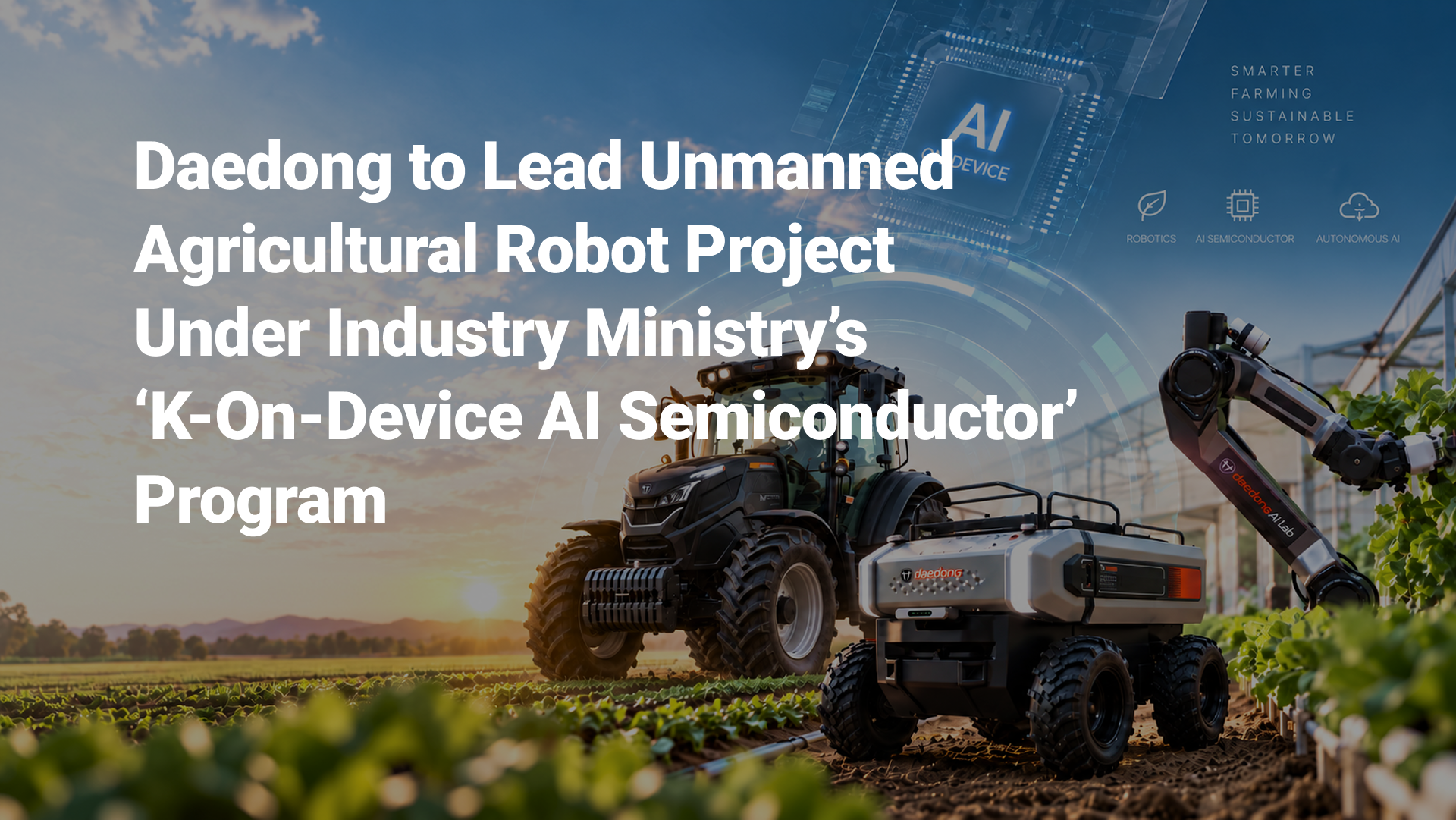
The project runs from July 2026 to December 2030, with a total budget of approximately KRW 43.1 billion and participation from 14 organizations across industry, academia and research. By developing and integrating Korean-developed AI chips, unmanned agricultural robot platforms and AI solutions for autonomous farming, the project aims to enable unmanned operation across key agricultural tasks, including crop protection, harvesting, transport and crop scouting.
‘K-On-Device AI Semiconductor Technology Development’ is a national R&D program to secure the AI chips needed for robots, automobiles, home appliances and other applications in the physical AI era using Korean technology and supply chains. The government is bringing together major end-user companies, including Hyundai Motor Company and LG Electronics, with Korean fabless chipmakers and foundries to build a Korean ecosystem spanning AI chip development and production through integration into finished products and demonstration. Within this initiative, Daedong will represent the agricultural sector and lead the application of Korean-developed AI chips to agricultural robots and their on-farm demonstration.
On-device AI is a technology that processes data on the device itself to perceive conditions and make decisions in real time, without relying on external servers. It is central to physical AI, which enables robots to understand their surroundings and work autonomously. The technology is particularly important for enabling reliable autonomous operation of AI-equipped agricultural machinery and robots in farming environments, where connectivity is limited and working conditions vary with crops, terrain and other factors.
Drawing on its experience developing and operating agricultural machinery and its understanding of on-farm conditions, Daedong will oversee technology integration, demonstration and commercialization across the project. In particular, it will apply the field data and AI enhancement know-how it has accumulated through selling and operating AI tractors to the project’s robot and AI development and demonstration. It will translate on-farm requirements—such as crop protection and harvesting performance, operating speed and AI decision-making time—into product specifications to guide chip and robot development, and establish the system architecture and interfaces linking the robot platforms and AI solutions. It will also draw extensively on the group’s accumulated AI and robotics capabilities, including Daedong AILab’s AI expertise, Daedong AgTech’s agricultural platform, and Daedong Robotics’ agricultural robots and its agricultural humanoid, ‘Agroid’.
The project comprises three subprojects: agricultural robots, AI chips and AI for autonomous farming. In the first subproject, Daedong Robotics will develop an unmanned robot platform for precision farming and modular implements, with participation from Rainbow Robotics, KORAS Robotics, HAN-A SS, the Korea Institute of Robotics & Technology Convergence, the Korea Agriculture Technology Promotion Agency and the National Institute of Agricultural Sciences. In the second subproject, fabless chipmaker Mobilint and the Korea Electronics Technology Institute will develop AI chips and a development environment optimized for agricultural conditions. In the third, MOBILUS, Daedong AgTech, SURESOFTTECH and Seoul National University will develop AI solutions for autonomous farming and a computing platform.
The AI system-on-chip (SoC), a core development target, will be designed to run multiple AI functions on the robot itself, processing camera and sensor data to enable autonomous driving, crop recognition and obstacle avoidance. The project aims to develop core technologies and prototypes from 2026 to 2028. From 2029 to 2030, the technology will be integrated into robots to validate autonomous farming performance—including crop protection, harvesting, transport and crop scouting—on working farms and lay the groundwork for commercialization.
The initiative is intended to reduce reliance on foreign-made AI computing modules, build experience in applying Korean-developed AI chips to agriculture and establish a supply chain for those chips. Daedong plans to extend the technologies beyond unmanned agricultural robots to major product lines, including tractors, rice transplanters and combine harvesters, broadening the Agricultural Physical AI ecosystem based on Korean-developed AI chips.
The ‘K-On-Device AI Semiconductor Technology Development’ program is a national R&D initiative to develop Korean AI chips, modules, driver software and related components in an integrated manner for four key industries. It is led by the Ministry of Trade, Industry and Resources and managed by the Korea Planning & Evaluation Institute of Industrial Technology (KEIT) as the designated implementing agency. With a total budget of approximately KRW 800.2 billion through 2030, it will support the development and production of 10 types of AI chips tailored to end-user companies, as well as their integration into finished products and demonstration.