
Daedong Sustains Growth with Record 2025 Revenue and 68% Surge in Operating Profit
-. A global diversification strategy across products, markets, and dealer networks at home and abroad drives the company’s highest annual revenue to date
-. Overseas operations remain resilient, with North America and Europe revenue rising by KRW 94.9 billion year over year despite market contraction and tariffs
-. Daedong to reposition itself as an AI and robotics company in 2026, expanding its AI tractors, robotics, precision agriculture, and smart farming businesses
Daedong (Co-CEOs Kim Jun-sik and Won Yu-hyun), a leader in future agriculture, announced on March 12, 2026, that it posted provisional consolidated revenue of KRW 1.475 trillion in 2025, up 4.2 percent year over year and marking the highest annual revenue in its history.
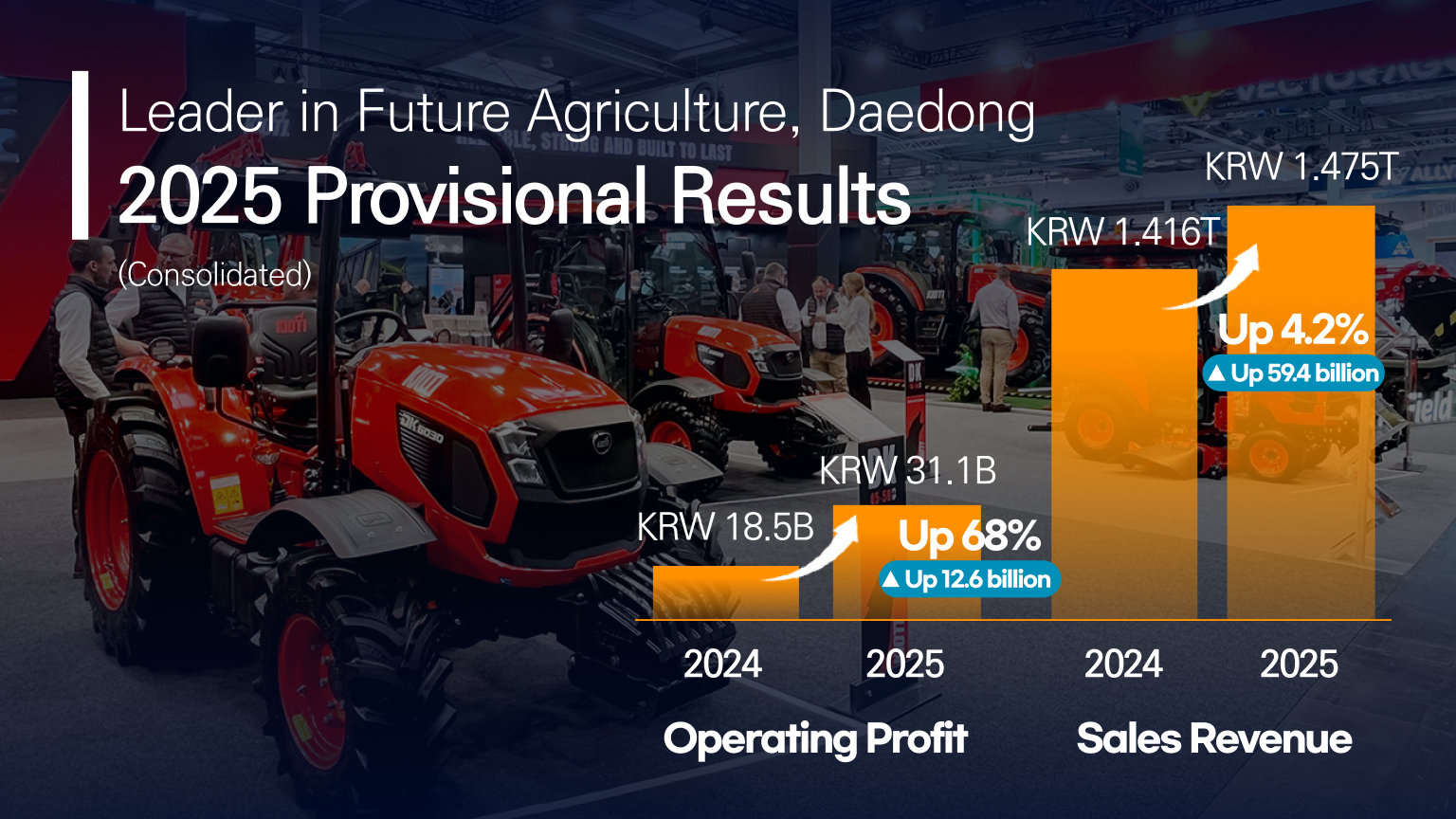
The results mark a return to growth following a two-year adjustment period after revenue peaked at KRW 1.4637 trillion in 2022. The company not only regained momentum but also surpassed its previous record. Operating profit climbed to KRW 31.1 billion, rising 68.3 percent year over year, demonstrating a marked improvement in profitability. Net loss narrowed significantly to KRW 25.1 billion, substantially reducing the deficit.
The company said the performance reflects the success of its global diversification strategy across products, markets, and dealer channels. In Korea, even as the agricultural machinery market contracted, Daedong diversified its revenue streams by bringing future agriculture products to market, including transport robots and precision agriculture solutions. In the United States, it opened a new warehouse in Tacoma on the West Coast, expanding its sales footprint beyond its traditional East Coast base to serve customers nationwide. The company also reinforced its dealer network by recruiting new partners and introducing a structured onboarding program, strengthening its overall go-to-market capabilities.
In Europe, Daedong delivered double-digit revenue growth and increased its market share by 2.5 percent year over year. The company identified France, Germany, Spain, Italy, and Poland as priority markets and implemented tailored strategies based on detailed market analysis. It also strengthened service and logistics infrastructure across the region, laying the groundwork for sustained growth. Supported by these diversification efforts, consolidated revenue in North America and Europe rose by approximately 12.4 percent year over year, or KRW 94.9 billion, despite the global economic slowdown and tariff pressures. Meanwhile, Daedong improved earnings by driving operational efficiencies and reinforcing financial discipline through company-wide cost reductions, price adjustments, and lower financing expenses.
Daedong has designated 2026 as the first full year of execution in its transformation into an AI and robotics company, aiming to accelerate growth centered on future agriculture products and services. The company plans to integrate AI and robotics throughout the entire value chain, from product development to customer experience, so that innovative technologies and customer-driven products translate more directly into revenue and profitability. In Korea, Daedong will maintain its growth momentum by expanding sales of future agriculture solutions such as AI autonomous tractors, agricultural robots, drones, precision agriculture, and smart farming. It will also continue to upgrade its agricultural machinery parts and service business to strengthen recurring revenue streams.
Overseas, the company will grow its revenue base through market driven strategies. In North America, Daedong plans to recruit up to 100 new dealers this year, expand into the mid- and large-horsepower tractor segments, and diversify its revenue portfolio by expanding its compact construction equipment and parts businesses. In Europe, it will broaden sales of mid to large horsepower tractors while further strengthening its dealer network. The company also intends to expand its smart farming operations and robotics businesses as new long term growth drivers.