
Daedong Unveils 2030 Roadmap to Reach KRW 3.59 Trillion in Revenue and Transform into an Agricultural Physical AI Company
-. Daedong, Daedong Gear and Daedong Metals disclose value-up plans outlining AI- and robotics-driven mid- to long-term growth strategies Daedong targets KRW 3.59 trillion in revenue by 2030 through recurring revenue from its AI-powered agricultural operating platform and global expansion
-. Daedong Gear and Daedong Metals aim to reach KRW 1 trillion and KRW 240 billion in revenue by 2030, respectively, by entering the robot components and advanced materials businesses
Daedong, Daedong Gear and Daedong Metals, the three listed companies of Daedong Group, announced on May 7, 2026, that they had disclosed their corporate value-up plans, which set out mid- to long-term growth strategies and shareholder return policies centered on Agricultural Physical AI. The plans mark a strategic move to build a foundation for sustainable growth by expanding beyond the Group’s traditional agricultural machinery-focused business structure into AI-powered agricultural operating platforms, robotics and advanced materials.
Founded in 1947, Daedong has played a leading role in the mechanization of Korean agriculture as the first company in the country to supply fully assembled agricultural machinery, including tractors, combines and rice transplanters. The company has since continued to strengthen its competitiveness together with Daedong Gear and Daedong Metals by building a vertically integrated structure for key power transmission components used in agricultural machinery and equipment, including transmissions, gears and engine castings.
Daedong Group is now working to evolve beyond agricultural machinery manufacturing and become an Agricultural Physical AI company. At the center of this transformation is Daedong’s plan to create a subscription-based AI agricultural service model built around AI-powered autonomous agricultural machinery and agricultural robots. The model will enable the company to collect and learn from agricultural data, while continuously improving equipment functions and performance through over-the-air (OTA) software updates. Daedong also plans to integrate AI agricultural agent services covering both open-field precision farming and greenhouse smart farming. Through this shift, the company aims to move beyond one-time equipment sales and transition toward a recurring revenue model centered on AI agricultural operating solutions.
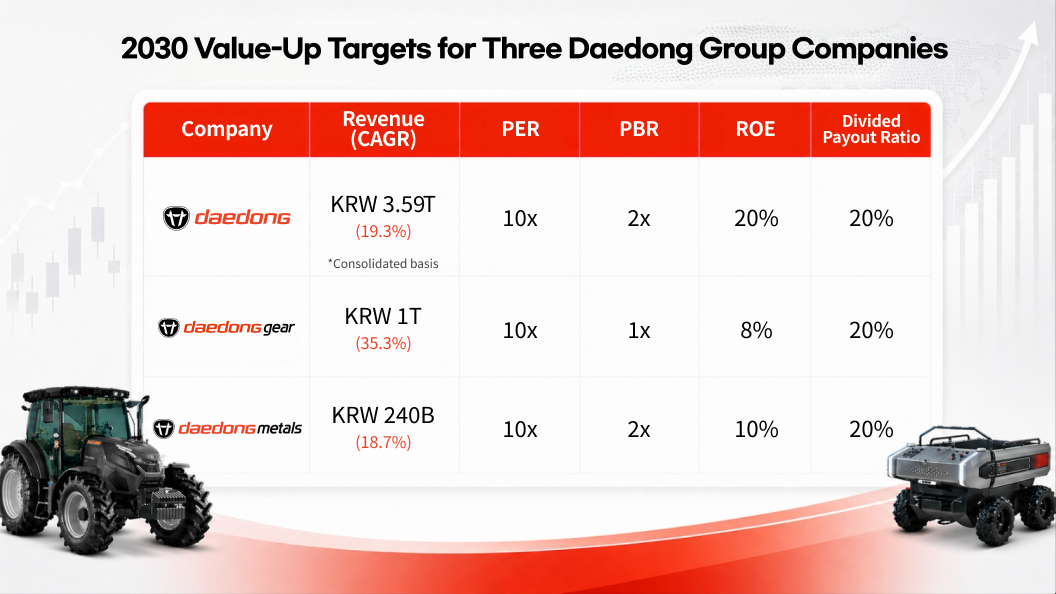
Daedong also outlined plans to scale this revenue model globally. By 2030, the company aims to build a dealer network of more than 1,000 locations in North America and more than 700 in Europe, its two key overseas markets. Through this expansion, Daedong plans to raise the share of revenue from new businesses from 11.9% in 2025 to 25.9% by 2030. The company has also set 2030 targets of KRW 3.59 trillion in consolidated revenue, a price-to-earnings ratio (PER) of 10x, a price-to-book ratio (PBR) of 2x and return on equity (ROE) of 20%.
Daedong Gear plans to expand its electric vehicle parts business while entering the market for core robot components, including reducers and actuators, in alignment with the Group’s robotics business. In electric vehicle parts, Daedong Gear will seek to improve profitability by advancing from a business model centered on individual parts to one focused on modules and systems. The company also plans to increase the share of external customers by strengthening its global customer response capabilities and order pipeline management. In core robot components, Daedong Gear aims to enhance the hardware competitiveness of the Group’s robotics products and move quickly with strategic investments to support early market entry. Daedong Gear has set 2030 targets of KRW 1 trillion in revenue, a PER of 10x, a PBR of 1x and ROE of 8%.
Daedong Metals plans to expand beyond its existing casting business, which has mainly served the agricultural machinery, automotive and construction equipment sectors, into higher-value areas such as core components for vacuum pumps used in semiconductor manufacturing processes and high-precision cast parts for defense and marine engines. The company also plans to develop an advanced materials business based on heat-dissipating, flame-retardant and eco-friendly composite materials, diversifying its portfolio toward high-growth industries such as AI data centers, electric vehicles, and electrical and electronic materials. In addition, Daedong Metals will strengthen its productivity and quality competitiveness through manufacturing AI-based process innovation. The company has set 2030 targets of KRW 240 billion in revenue, a price-to-earnings ratio (PER) of 10x, a price-to-book ratio (PBR) of 2x and return on equity (ROE) of 10%.
Meanwhile, the three listed companies plan to gradually raise their dividend payout ratios to around 20% by 2030 to make shareholder returns more predictable. Building on their long track records of consecutive dividend payments, 32 years for Daedong, 24 years for Daedong Gear and 30 years for Daedong Metals, the companies aim to strengthen investor confidence by presenting clear mid- to long-term dividend policies. They also plan to step up investor communication by building a C-level-led investor relations structure, expanding investor briefings in Korea and overseas, and enhancing English-language disclosures.