
Daedong Rolls Out Three DJI Drone Models, Stepping Up Push into Korea’s Agricultural Drone Market
-. A three-model lineup—T25, T50 and T70P—offers more choice for different farm sizes and operating conditions.
-. As one of only two official DJI distributors in Korea, Daedong is targeting the market through a service network of about 150 locations.
-. Plans to advance data-driven farming operations include exploring links between DJI drones and precision agriculture services.
Daedong (Co-CEOs Kim Jun-Sik and Won Yu-Hyun), a leader in future agriculture, announced on July 16, 2026, that it is launching full-scale distribution of agricultural drones from global drone company DJI in Korea.
Korea’s drone market continues to grow, with use expanding rapidly, particularly in agriculture. About 4,000–5,000 agricultural drones are sold in Korea each year, and Daedong aims to sell more than 1,000 units a year on average through its entry into the market.
According to global market research firm Grand View Research, Korea’s agricultural drone market reached approximately USD 102.7 million (approximately KRW 140 billion) in 2025. It is projected to expand at a compound annual growth rate (CAGR) of 21.1% from 2026 to 2033, reaching approximately USD 467.1 million (approximately KRW 650 billion).
DJI holds the largest share of Korea’s agricultural drone market. Only two companies are currently authorized to sell DJI agricultural drones in Korea. Daedong plans to step up its market push, drawing on its approximately 150 dealerships nationwide and its service network to provide on-the-ground support from purchase consultations to after-sales service.
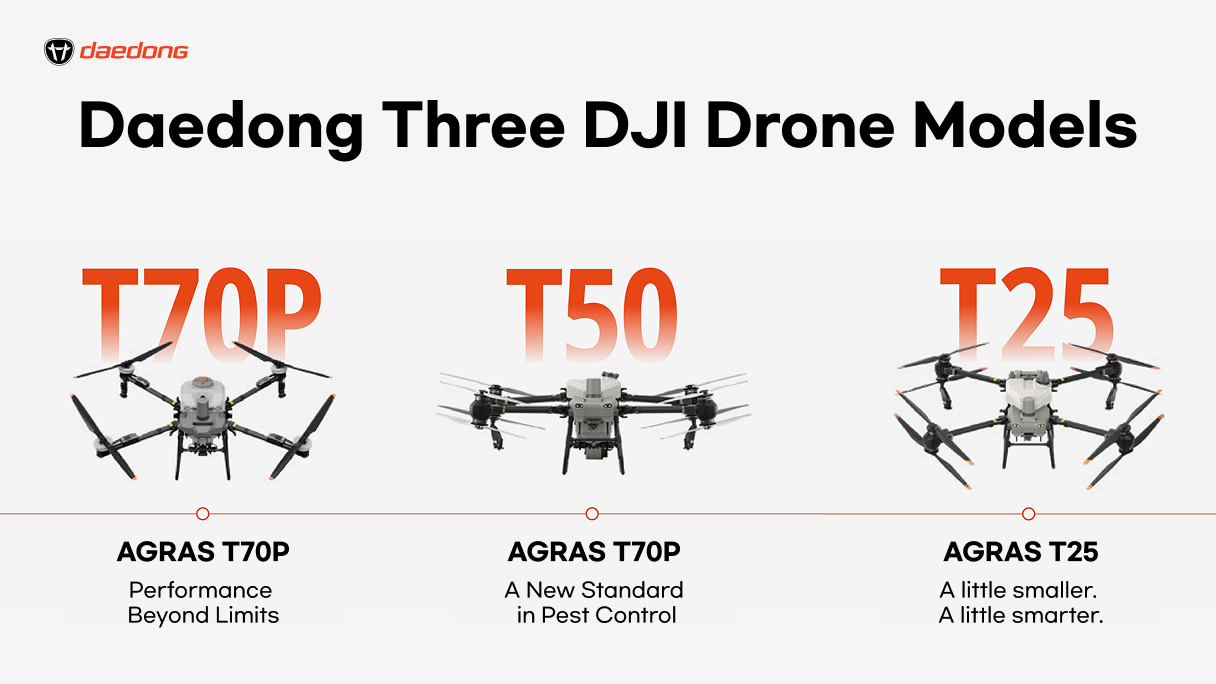
Daedong’s DJI agricultural drone lineup for Korea comprises three models: T25, T50 and T70P. The range extends from compact drones suited to small and medium-sized plots to models for large farms, offering more choice to suit different farm sizes and operating conditions. Each model can be used for a variety of agricultural tasks, including pest and disease control, fertilizer application and farmland surveying.
Among the three models, the T25 and T50 are suited to farmland ranging from small and medium-sized plots to large fields. Both offer surveying capabilities that enable them to map 10–13 hectares (about 30,000–40,000 pyeong) of farmland in just 10 minutes. Their sensing systems combine binocular vision and radar to support stable flight even in environments with numerous obstacles.

The T25 is a compact drone with payload capacities of 20 kg for crop protection chemicals and 25 kg for granular materials, and a maximum spray rate of 24 L per minute. Its ‘solenoid valve system’ reduces chemical leakage during transit by ensuring that chemicals are sprayed only when needed. With payload capacities of 40 kg for spraying and 50 kg for spreading, the T50 can handle large-scale operations. Its ‘dual atomizing centrifugal nozzles’ support uniform, precise application even across large areas.

The T70P, an extra-large agricultural drone, is equipped with a 70 kg chemical tank and a 70 kg granular material tank, making it suitable for work on large farms. With a maximum chemical application rate of 40 L per minute and a maximum granular spreading rate of 400 kg per minute, it can quickly cover vast areas. Four water-cooled atomizing nozzles allow precise control of droplet size.

Following the drone rollout, Daedong is also considering expanding technical cooperation with DJI and strengthening links with its own precision agriculture services. It plans to link operational histories, application data and information on farmland and crop conditions obtained from DJI agricultural drones to its precision agriculture platform, further developing data-driven services that span diagnosis, prescription and execution of farming operations.