
Daedong Forecasts KRW 130 Billion in 2026 Parts Revenue, Strengthens AI-Based Recurring Revenue
-. Wider deployment of autonomous farming equipment and enhanced operations management services are expanding parts and aftermarket revenue.
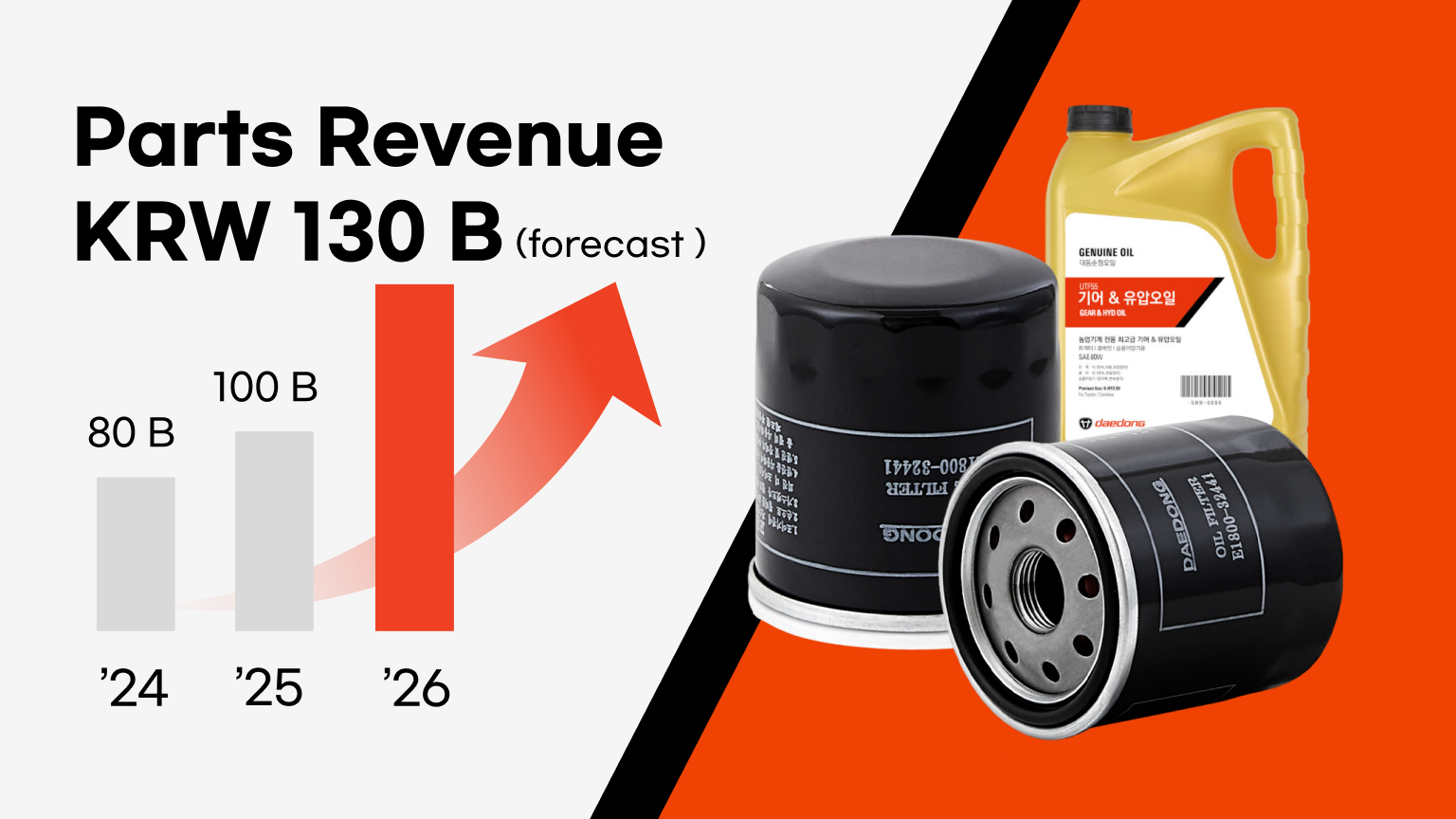
-. Parts revenue rose from KRW 81 billion in 2024 to KRW 100 billion in 2025 and is forecast to reach KRW 130 billion in 2026, with a target of KRW 300 billion in 2030.
-. Stronger service policies, channels and supply chains, a broader product lineup and enhanced AI-based equipment management are driving growth.
Daedong (Co-CEOs Kim Jun-Sik and Won Yu-Hyun), a leader in future agriculture, announced on July 14, 2026, that it is strengthening the recurring revenue base of its parts and aftermarket businesses by expanding the deployment of autonomous farming equipment and enhancing operations management services through its AI agricultural platform.
Daedong’s AI agricultural platform integrates every stage of farming, connecting agricultural data collection, AI-based farming decisions, autonomous farming operations and equipment management in a single operational system. Building on this platform, Daedong is expanding a service-based business model that maintains ongoing connections with customers after equipment sales through parts replacement, regular inspections and software updates.
Parts revenue rose 24% from approximately KRW 81 billion in 2024 to approximately KRW 100 billion in 2025. It is forecast to grow a further 30% year on year to approximately KRW 130 billion in 2026, with Korea expected to account for 30% of revenue and overseas markets for around 70%. The company attributed this growth primarily to initiatives pursued over the past two to three years in line with its AI agricultural platform strategy: stronger service policies, expanded service channels in Korea and overseas, a stronger global supply chain, a broader product lineup and more advanced AI-based equipment management.
Daedong is expanding customer touchpoints by strengthening service policies in Korea and overseas. It offers industry-leading warranty and service policies, including free 10-year/3,000-hour warranty coverage for tractor engines and transmissions and free inspections of agricultural machinery at 50 operating hours. In 2025, the company also launched extended warranty products in Korea and overseas, allowing customers to receive free inspections and repairs for up to three additional years after the standard warranty expires.
The expansion of service channels has also played a key role. In 2025, Daedong introduced “Daedong Service Master” centers in Korea, specializing in maintenance and repairs without selling agricultural machinery. The model is designed to complement the existing after-sales service network centered on sales dealerships and strengthen specialist maintenance services. Two centers opened in the first half of 2026 in regions including Jeollanam-do and Chungcheongbuk-do. Daedong plans to open two more in the second half of 2026 to strengthen its nationwide maintenance and service capabilities.

(In April 2026, Daedong opened the industry’s first Service Master centers in Naju-si, Jeollanam-do, and Cheongju-si, Chungcheongbuk-do, bringing its service system based on authorized maintenance channels into full operation. The two centers serve as regional service hubs covering all of Jeonnam and Chungcheongbuk-do, respectively. Officials pose for a photo at the opening ceremony for the Daedong Service Chungbuk Master Center.)
Daedong is also stepping up efforts to strengthen its global supply chain. In 2025, the company established an integrated logistics warehouse spanning approximately 8,900 pyeong in Tacoma, Washington, U.S. The facility can store approximately 4,000 types of parts and serves as a hub for pre-positioning service parts in western North America, improving customer response times and supply reliability. By 2027, Daedong plans to expand its logistics handling capacity to strengthen global parts distribution. It will also consider introducing AI and automation systems into warehouse operations.
In parallel, Daedong is accelerating efforts to expand its North American KIOTI dealer network from approximately 570 dealers at the end of 2025 to 1,100 by 2030. Expanding sales channels naturally leads to increased parts demand and growth in after-sales service revenue. In particular, Daedong is pursuing quality-driven growth by improving dealer profitability and service quality to build long-term demand for parts and maintenance.

A broader product lineup to support the wider adoption of autonomous farming operations is also contributing to growth in the parts business. Daedong is expanding into compact construction equipment, including skid steer loaders and mini excavators, in overseas markets. In Korea, it has been expanding sales of new equipment, including AI tractors, DEUTZ-FAHR tractors, drones and transport robots, since the start of 2026. Demand for replacement parts and maintenance arising from the operation of these machines is expected to increase accordingly.

Alongside its broader product lineup, Daedong is enhancing equipment operations management and timely parts supply through the Connect app, which is based on its AI agricultural platform. The app allows headquarters and dealerships to check the condition of agricultural machinery engines, transmissions and key components, as well as maintenance histories and parts replacement intervals. Using this information, they can anticipate when consumables need replacing and identify parts at risk of failure, helping ensure the right parts are supplied. The company also offers consultations on equipment issues, fault checks, and recommendations for parts and maintenance services across its agricultural machinery lineup through its AI chatbot, “AI Daedongi.”
Daedong will also work to develop subscription-based service offerings by 2027. Moving beyond one-off parts sales and maintenance services, the company plans to develop offerings that combine regular inspections, consumables replacement, remote diagnostics, extended warranties and equipment operations management. The aim is to reduce customers’ equipment maintenance burden while expanding the company’s stable base of recurring revenue. Daedong aims to achieve KRW 300 billion in parts revenue in 2030 through wider deployment of autonomous farming equipment, AI-based equipment management services, and the establishment of parts demand forecasting and predictive maintenance systems.